Oral appliance therapy for obstructive sleep apnea and snoring in West Hills, CA, using custom mandibular advancement devices titrated to sleep-study data.
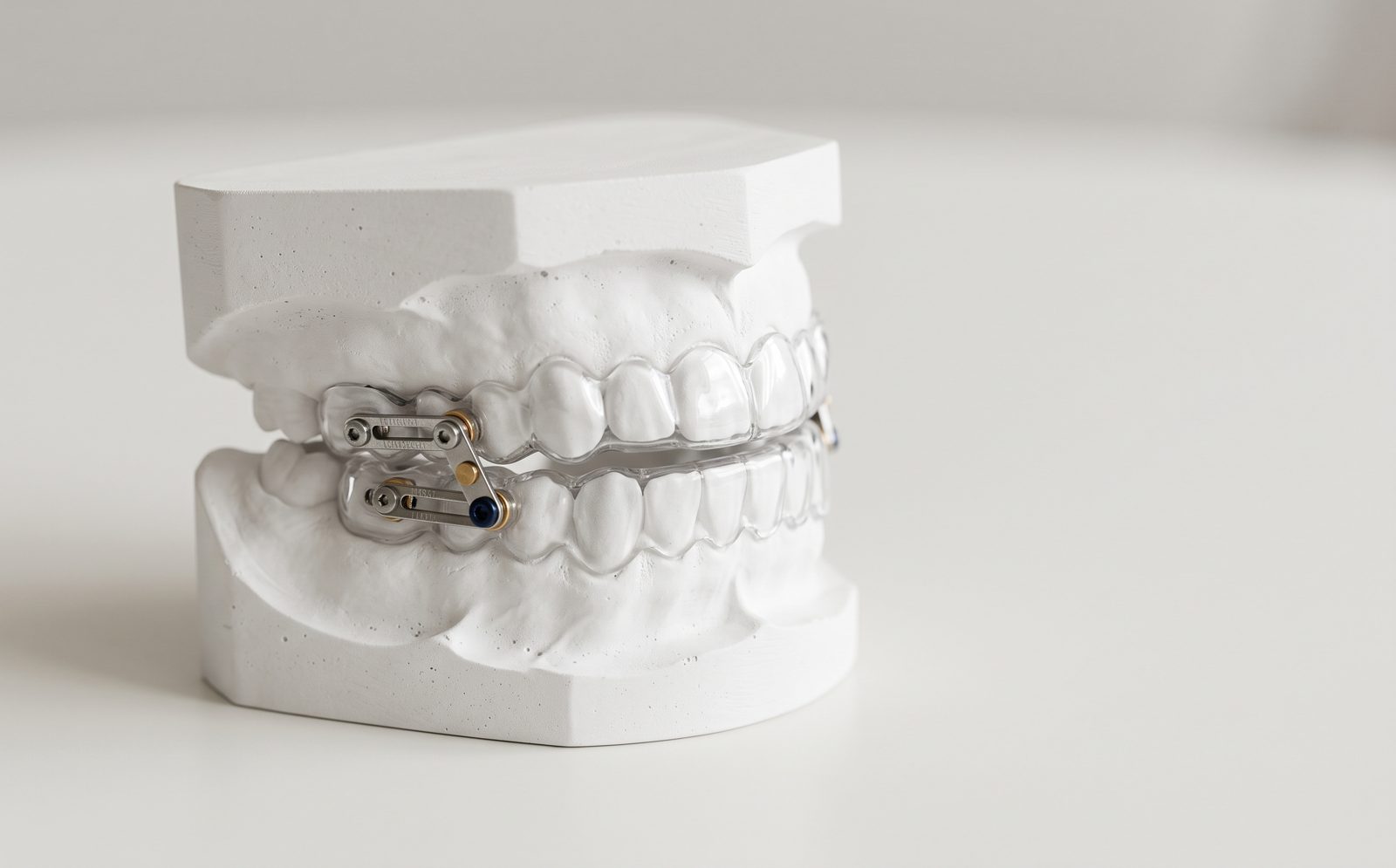
How an Oral Appliance Treats Sleep Apnea
In obstructive sleep apnea, the airway at the back of the throat narrows or closes during sleep, so breathing repeatedly stops or becomes shallow. A sleep study measures how often this happens each hour: 5 to 14 events is mild, 15 to 29 is moderate, and 30 or more is severe. A physician makes the diagnosis.
A mandibular advancement device is a custom mouthpiece worn at night. It holds the lower jaw slightly forward, which:
- moves the base of the tongue forward, opening the space behind it
- keeps the muscles of the tongue and throat firmer
- helps keep the side walls of the throat from collapsing
The appliance is adjusted forward in small steps over several visits until symptoms improve and it remains comfortable. It is a common choice for mild to moderate sleep apnea, and for people with more severe sleep apnea who cannot use CPAP.
Within Dental Sleep Medicine
This page is the overview. Detailed pages cover each part of care:
What Happens at Each Visit
- Records and referral. Your sleep study report and any physician referral are reviewed before the first visit. If you have not had a sleep study, the office coordinates with your physician, because obstructive sleep apnea must be diagnosed by a physician.
- Evaluation. Medical and sleep history, examination of the jaw joints, jaw muscles, teeth and gums, and an airway-focused examination. Imaging is obtained only when clinically indicated.
- Records for fabrication. Digital scans or impressions and a bite registration are taken so the appliance can be custom made.
- Delivery. The appliance is fitted, adjusted for comfort, and you are shown how to place, remove and clean it, along with a morning jaw exercise.
- Titration. Over several short visits the lower jaw is advanced in small steps while symptoms, comfort and jaw function are monitored.
- Confirming the result. When titration is complete, your physician orders follow-up sleep testing to confirm the appliance is controlling the apnea.
- Long-term follow-up. Periodic visits check the fit, the device, the jaw joints and the bite, since appliances wear and can be adjusted over time.
Working With Your Physician
Your physician remains responsible for the diagnosis of sleep apnea and for ordering sleep testing. The practice sends a written report after the evaluation and after titration, and coordinates the follow-up sleep study. Patients with severe sleep apnea, significant medical conditions, or symptoms that persist with the appliance are discussed with the physician, and combination therapy (for example, an appliance together with positional therapy or CPAP) may be considered.
Insurance and Medicare
Custom oral appliances for obstructive sleep apnea are usually billed to medical insurance rather than dental insurance, as durable medical equipment under HCPCS code E0486 (custom-fabricated mandibular advancement device).
Medicare and most medical plans require documentation such as: a diagnosis of obstructive sleep apnea from a sleep test interpreted by a physician; an order from the treating physician; and a custom-fabricated device. For more severe sleep apnea, Medicare generally also requires documentation that CPAP was not tolerated or is contraindicated. Deductibles, prior authorization and coverage differ by plan, so benefits are verified before the appliance is made.
Possible Side Effects
Most side effects are mild and temporary: tooth or jaw soreness in the morning, increased saliva or a dry mouth, and a temporary change in how the back teeth meet on waking. Over years of use, small permanent changes in the bite can occur. Regular follow-up visits monitor for these changes and include exercises and adjustments to limit them.
Common Questions
Do I need a sleep study before getting an oral appliance?
Yes. Obstructive sleep apnea must be diagnosed by a physician, usually with a home sleep test or an in-lab study. The appliance is made after the diagnosis.
Is an oral appliance as effective as CPAP?
CPAP usually lowers the apnea-hypopnea index more. Many patients use an oral appliance more consistently, so overall benefit can be similar for appropriate patients. The choice is made with your physician based on your sleep study.
Does medical insurance cover oral appliance therapy?
Often, when the documentation requirements are met. Custom oral appliances are billed to medical insurance as durable medical equipment (HCPCS E0486). Coverage varies by plan and is verified before fabrication.
How long does the process take?
From the first evaluation to a completed titration typically takes several weeks, followed by a confirmation sleep study ordered by your physician.
Will an oral appliance stop snoring?
It often reduces snoring. Snoring alone should still be evaluated, because it can be a sign of sleep apnea.
Clinical details for referring providers
Obstructive Sleep Apnea: Diagnostic Metrics
Obstructive sleep apnea (OSA) is diagnosed and classified by polysomnography (PSG) or home sleep apnea testing (HSAT) using the Apnea-Hypopnea Index (AHI) and Respiratory Disturbance Index (RDI):
- Mild OSA: AHI/RDI 5-14 events per hour
- Moderate OSA: AHI/RDI 15-29 events per hour
- Severe OSA: AHI/RDI ≥30 events per hour
Diagnosis and severity classification are performed by a physician based on sleep study results; oral appliance therapy is provided upon physician referral and prescription.
Mechanism of Action: Mandibular Advancement Devices
Mandibular advancement devices (MADs) reposition the mandible anteriorly, producing the following physiological effects on upper airway collapsibility:
- Anterior displacement of the tongue base, increasing retroglossal airway space
- Increased tension in the genioglossus, geniohyoid, and palatoglossus muscles via mechanical traction
- Reduction in pharyngeal lateral wall collapsibility, measured by reduction in the critical closing pressure (Pcrit) of the upper airway
- Stabilization of the hyoid bone position, reducing posterior airway space variability during sleep
Titration Protocol
- Baseline impressions and bite registration at a sub-maximal protrusive position (typically 60-70% of maximum protrusion)
- Appliance delivery and initial fit verification
- Incremental mandibular advancement in increments of approximately 0.25-1.0 mm per adjustment, guided by symptom resolution and patient tolerance
- Objective titration confirmation via follow-up HSAT or PSG with the appliance in place at the titrated position
- Periodic follow-up to assess appliance fit, occlusal changes, and continued efficacy
Indications
Oral appliance therapy is indicated for mild to moderate OSA as a first-line alternative to CPAP; severe OSA in patients who are CPAP-intolerant or CPAP-refusing, per American Academy of Sleep Medicine (AASM) and American Academy of Dental Sleep Medicine (AADSM) joint clinical practice guidelines; and primary snoring without OSA, when clinically indicated.
Related Conditions
Patients are seen at the West Hills office from Los Angeles County, Ventura County, West Hills, Canoga Park, Woodland Hills, Calabasas, Sherman Oaks & Encino, Northridge & Chatsworth, Thousand Oaks, Simi Valley, Agoura Hills & Westlake Village.
