If you snore, wake up gasping, or a partner has noticed you stop breathing at night, you may have already heard about CPAP machines. An oral appliance is a custom, mouthguard-like device worn during sleep that repositions the jaw to help keep the airway open, and represents an alternative treatment approach to CPAP for specific patient populations, as described below.
Key Points
- Oral appliance therapy (OAT) uses a custom-fitted device to advance the lower jaw and open the airway during sleep.
- Professional guidelines support OAT for mild-to-moderate obstructive sleep apnea (OSA) and primary snoring, and as an option for severe OSA in patients who cannot tolerate CPAP.
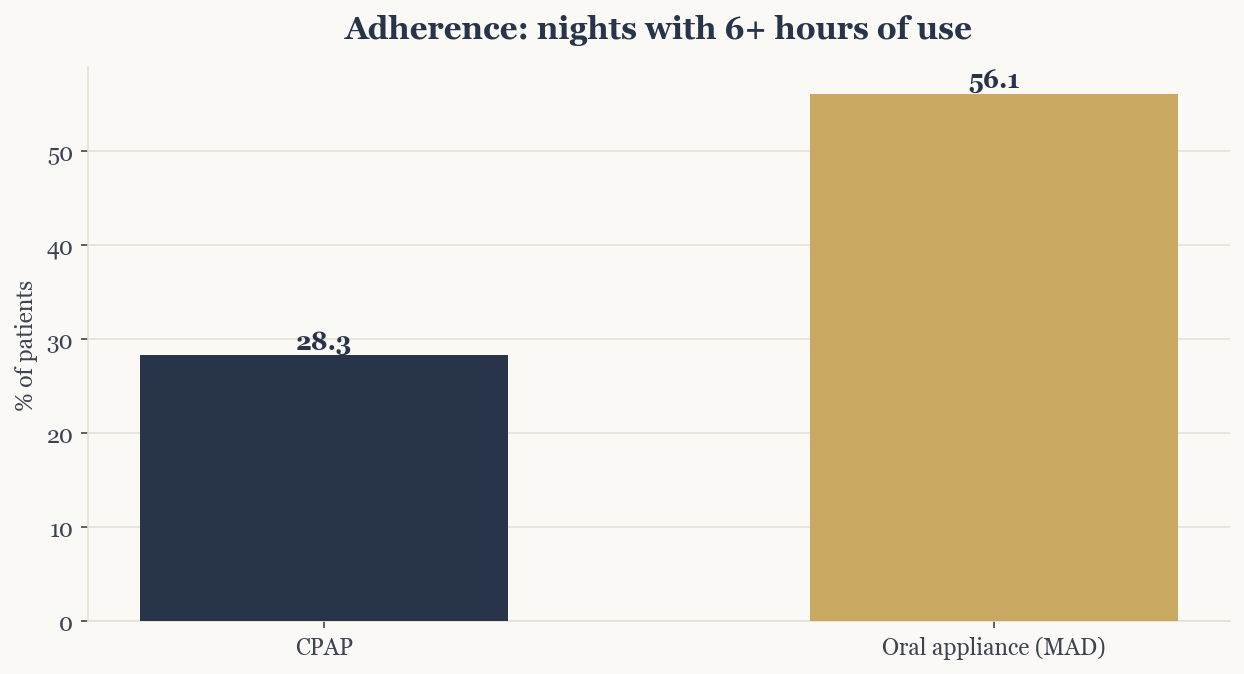
- CPAP produces a larger reduction in the apnea-hypopnea index (AHI) in a randomized substudy, while oral appliances show higher nightly adherence in the same trial (PMID 40888163); a separate crossover study reported statistically non-inferior symptom relief with oral appliances, though its authors note that the sequential design cannot separate treatment from order effects and that the primary outcome lacks validation, precluding a definitive non-inferiority conclusion (PMID 42475493).
- Real-world adherence monitoring shows patients often overestimate how consistently they wear their appliance (PMID 42469518).
- Long-term use requires periodic follow-up with a trained dentist to manage bite changes and jaw joint symptoms.
What is oral appliance therapy?
An oral appliance is a device, similar in appearance to an orthodontic retainer, that fits over the upper and lower teeth and holds the lower jaw in a slightly forward position during sleep. This mandibular advancement is believed to reduce airway collapse by advancing the tongue base and stabilizing surrounding soft tissue, through mechanisms — including genioglossus and hyoid advancement, enlargement of the retroglossal and velopharyngeal airway space, and altered upper-airway dilator muscle activity — that are not fully characterized.
Professional guidelines from the American Academy of Dental Sleep Medicine describe oral appliances as indicated for mild-to-moderate OSA and primary snoring, and as an accepted therapy for severe OSA in patients who cannot or will not tolerate positive airway pressure (CPAP). Appliances are custom-made and adjusted (titrated) gradually by a qualified dentist to find the jaw position that controls symptoms while remaining tolerable to wear nightly.
How is sleep apnea diagnosed?
OSA is diagnosed with a sleep study — either an in-lab polysomnogram or a home sleep apnea test — that measures the apnea-hypopnea index (AHI), the number of breathing pauses per hour of sleep. Severity is generally classified as mild (5–15 events/hour), moderate (15–30), or severe (>30), though clinical decisions also account for oxygen desaturation, symptoms like daytime sleepiness, and cardiovascular risk factors. A 2026 clinical overview notes that OSA diagnosis and management have expanded beyond sleep specialists into primary care, with mandibular advancement devices now recognized as one of several established treatment options alongside CPAP, positional therapy, weight management, and surgery (PMID 42441964).
Which treatment is right for me?
The choice between CPAP, an oral appliance, and other options depends on OSA severity, anatomy, and — importantly — which treatment a patient will actually use every night.
| Option | What the evidence shows | Best suited to |
|---|---|---|
| CPAP | Greater reduction in breathing events; residual AHI 2.1/h vs 20.9/h with oral appliance in severe OSA (PMID 40888163) | Severe OSA where maximal event suppression is the priority |
| Oral appliance (MAD) | No significant difference from CPAP in symptom alleviation in a 94-patient crossover study, though the authors state their design cannot separate treatment from order effects and that the primary outcome lacks validation against patient-important outcomes, precluding a definitive non-inferiority conclusion (PMID 42475493); higher nightly adherence and measurable blood pressure reduction in severe OSA (PMID 40888163) | Mild-to-moderate OSA, primary snoring, or severe OSA with CPAP intolerance |
| Positional therapy | Part of the recognized multimodal treatment pathway (PMID 42441964) | OSA concentrated in supine sleep position (general clinical criterion; positional therapy specifics are not detailed in the cited source) |
| Maxillomandibular advancement (surgery) | Improves AHI, sleepiness, and oxygen saturation nadir regardless of gender; surgical cure rates decline with age (OR 0.97 per year) in a meta-analysis with modest aggregate sample size and heterogeneity across the 36 included studies (PMID 42473733) | Anatomic surgical candidates, often after appliance or CPAP failure |
Neither device eliminates every breathing event, and the trade-off is consistent across studies: CPAP suppresses more events per hour, while oral appliances tend to get worn more consistently. In one 12-month trial, this translated into a measurable blood pressure benefit with the appliance despite CPAP’s larger AHI reduction (PMID 40888163) — a reminder that AHI reduction and downstream health outcomes don’t always move together, and that the “right” therapy is the one a patient will use.
How well do people stick with it?
Adherence is not automatic with either device. A one-year pilot study using an embedded thermal sensor found that only 49% of oral appliance users met a ≥4 hour/night use threshold at 3 months, falling to 44% at 12 months — and patients consistently overestimated how often they wore the device, even when they accurately reported how long they wore it on nights they did (PMID 42469518). Older age, lower baseline daytime sleepiness scores, and smaller mandibular plane angle were associated with better adherence in this pilot cohort of 49 patients. This is a practical argument for objective adherence tracking, not just relying on how a patient describes their own use. A separate, in-progress practice-based study is examining how different appliance titration approaches (adjusting the jaw position over time) affect outcomes in real-world dental office settings; results are not yet published (PMID 42378307).
Dental side effects to watch for
Before an appliance is fitted, candidacy is assessed for adequate dentition and periodontal support to retain the device, and for pre-existing temporomandibular joint (TMJ) disorder, since appliance design and titration approach require particular consideration in patients with baseline TMD. Nightly appliance wear can also shift bite alignment and tooth position over time, and some patients develop jaw joint (TMJ) discomfort, particularly during the titration period. This is why appliance therapy requires ongoing follow-up with a dentist trained in dental sleep medicine — to check occlusion, adjust the appliance, and manage any jaw joint symptoms early. Separately, a 2026 narrative review proposes that untreated OSA itself may stress dental restorations and implants through a combination of sleep bruxism and nighttime reflux, and that treating OSA (with either appliance or CPAP) may help stabilize the oral environment — though this remains a qualitative hypothesis requiring further prospective study (PMID 42479481).
When should I see a specialist?
Consult a sleep physician if you have loud snoring, witnessed breathing pauses, or unexplained daytime sleepiness — a sleep study is needed before any device is fitted. See a dentist trained in dental sleep medicine once OSA is diagnosed and CPAP is declined, not tolerated, or not preferred, or if you develop jaw pain, clicking, or bite changes during appliance use.
For referring providers
Oral appliance therapy is indicated for mild-to-moderate OSA and primary snoring, and is an accepted option for severe OSA in patients who cannot tolerate CPAP. In a 12-month randomized substudy of severe OSA, oral appliances showed lower adherence-adjusted event suppression than CPAP (residual AHI 20.9 vs 2.1/h) but higher adherence (56.1% vs 28.3% at ≥6h/night) and a measurable asleep blood pressure reduction (mean −4.7 mmHg) not seen with CPAP over the same period, an AHI–blood pressure dissociation the authors describe as unexplained (PMID 40888163). A separate non-randomized crossover study reported statistically non-inferior symptom alleviation with mandibular advancement devices versus CPAP, though the authors note the sequential design and unvalidated primary outcome preclude a definitive non-inferiority conclusion (PMID 42475493). For appliance failures or anatomic candidates, maxillomandibular advancement surgery shows consistent AHI and oxygenation improvement across genders, with declining cure rates as age increases (OR 0.97 per year), a finding drawn from a meta-analysis with modest aggregate sample size and heterogeneity across the 36 included studies (PMID 42473733). Emerging pharmacotherapy (e.g., atomoxetine/oxybutynin) shows early, modest, phenotype-dependent effects but remains investigational and is not FDA-approved for OSA (PMID 41932835).
This article is intended for general education and does not replace an individualized clinical evaluation. Candidacy for oral appliance therapy is determined through clinical evaluation.
References
- PMID 42479481 — Treatment of Patients with Obstructive Sleep Apnea Syndrome: What Shall Prosthodontists Consider? (Int J Prosthodont, 2026)
- PMID 42475493 — Comparative effectiveness of oral appliances and continuous positive airway pressure (Am J Respir Crit Care Med, 2026)
- PMID 40888163 — Mandibular Advancement Device versus CPAP in Severe Obstructive Sleep Apnea (J Dent Res, 2026)
- PMID 41932835 — Atomoxetine plus oxybutynin for obstructive sleep apnoea (Thorax, 2026)
- PMID 42473733 — Maxillomandibular Advancement Outcomes in Obstructive Sleep Apnea by Age and Gender (Laryngoscope, 2026)
- PMID 42378307 — The South Texas Oral Health Network Study (PAOSA) protocol (JMIR Res Protoc, 2026)
- PMID 42469518 — Objective and subjective adherence to oral appliance therapy (J Clin Sleep Med, 2026)
- PMID 42441964 — Obstructive Sleep Apnea (Ann Intern Med, 2026)
