Loud snoring, gasping awake, and daytime exhaustion aren’t just poor sleep — they can signal obstructive sleep apnea (OSA), a treatable breathing disorder. OSA occurs when the tissues at the back of the throat repeatedly collapse during sleep, blocking airflow and briefly waking the brain to restart breathing.
Key Points
- OSA is diagnosed by counting breathing pauses during sleep — the apnea-hypopnea index, or AHI (the number of pauses per hour) — using an in-lab or home sleep study.
- Continuous positive airway pressure (CPAP) suppresses breathing pauses most completely, but oral appliances are worn more consistently by many patients (PMID 40888163).
- Treatment is not one-size-fits-all: severity, anatomy, age, and personal tolerance all factor into which option is likely to help most.
- Untreated OSA has documented associations with hypertension, and evidence links it to broader cardiovascular and cognitive effects.
- Dentists have a role in both screening and managing the downstream effects of OSA on the mouth and teeth.
What is obstructive sleep apnea?
During sleep, the muscles that hold the throat open relax. In OSA, the airway narrows or closes completely, cutting off airflow for ten seconds or longer at a time. Oxygen levels drop, and the brain briefly rouses the body to reopen the airway — often without the person fully waking up. This can happen dozens of times an hour, fragmenting sleep even when the person doesn’t remember waking.
OSA is not a single condition with one cause. It reflects heterogeneous phenotypes — variation in airway anatomy, muscle tone, and arousal sensitivity — which is one reason no single treatment works for everyone (PMID 42498426).
The consequences extend beyond fatigue. Moderate-to-severe OSA is associated with cardiovascular morbidity and mortality (PMID 42498426), and treated OSA has been linked to lower rates of hypertension compared with untreated disease in longitudinal cohort data (Marin et al., JAMA 2012). Population data from the Busselton Health Study also associate untreated sleep apnea with increased long-term mortality risk. Cognitive domains — including verbal memory and executive function — have been studied in relation to OSA and its treatment as well.
How is it diagnosed?
OSA is diagnosed with a sleep study, either:
- In-lab polysomnography — the reference standard, recording brain activity, breathing, oxygen levels, and movement overnight.
- Home sleep apnea testing — a simplified version measuring airflow, effort, and oxygen saturation, appropriate for patients with a high pre-test likelihood of moderate-to-severe disease.
Both generate the AHI — the apnea-hypopnea index, or the number of breathing pauses per hour of sleep. Severity is categorized by this number: mild, moderate, and severe, with thresholds set by established sleep medicine criteria. The AHI, combined with symptoms (daytime sleepiness, witnessed pauses, morning headaches) and oxygen saturation nadir, guides the treatment discussion.
What are the treatment options?
| Option | What the evidence shows | Typically best suited to |
|---|---|---|
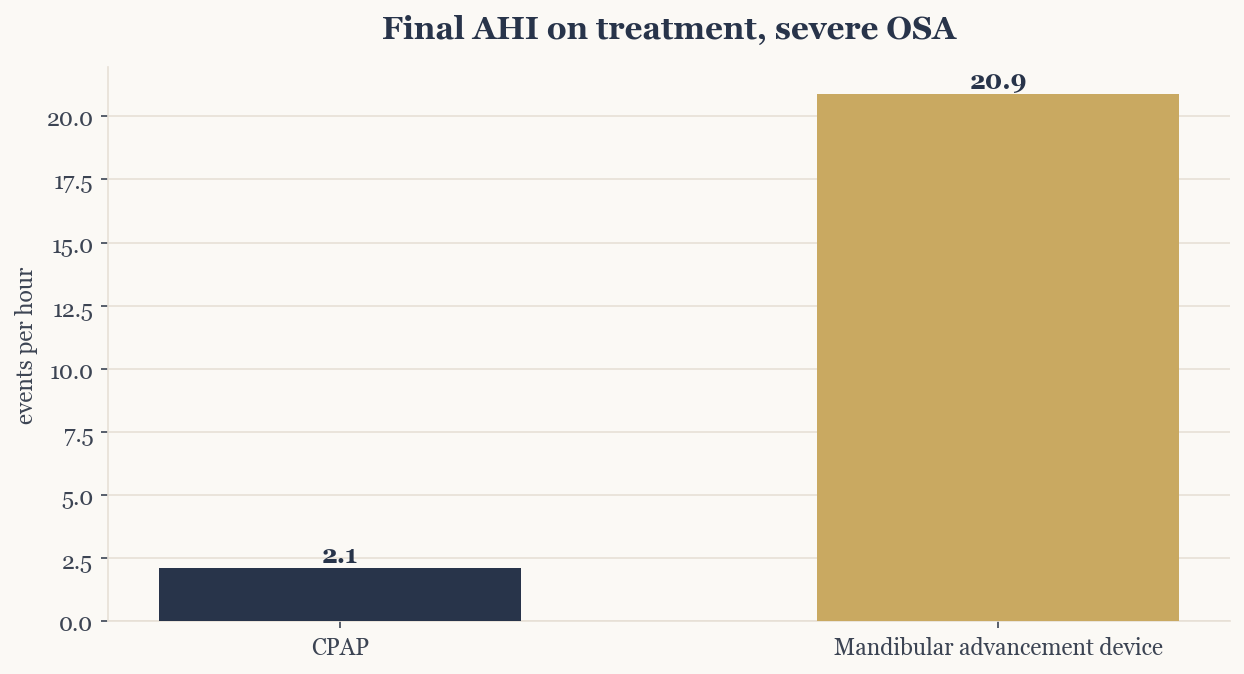
| CPAP (continuous positive airway pressure) | Most effective at suppressing breathing events — final AHI 2.1/h vs. 20.9/h with an oral appliance in one severe-OSA trial (PMID 40888163) | Patients who tolerate the mask; often first-line for severe OSA |
| Oral appliance (mandibular advancement device) | Lower nightly event suppression than CPAP, but higher adherence (56.1% vs. 28.3% used ≥6h/night) and measurable reduction in asleep blood pressure (PMID 40888163); a separated-type design reduced AHI from 17.4 to 8.2/h in mild-to-moderate patients (PMID 42505766) | Mild-to-moderate OSA, or CPAP intolerance |
| Maxillomandibular advancement (MMA) surgery | Significant AHI, sleepiness, and oxygen nadir improvement across sexes; surgical cure rates decline with age (OR 0.97 per year) though overall improvement is preserved (PMID 42473733) | Selected anatomic candidates, often younger patients or those who decline lifelong device use |
| Hypoglossal nerve stimulation | Included among non-CPAP options in current reviews of the therapeutic landscape (PMID 42498426) | Patients who have failed or cannot tolerate CPAP, per specialist evaluation |
| Emerging pharmacotherapy | Investigational; early trials show modest or phenotype-dependent AHI reduction, not yet ready for routine use (PMID 41932835, PMID 42148507) | Not currently a standalone option outside of research settings |
Which treatment is right for me?
The choice weighs event suppression against real-world use. In one 12-month trial of severe OSA, CPAP eliminated more breathing events, but fewer patients wore it consistently — and it was the oral appliance group that showed a measurable drop in asleep blood pressure, while CPAP did not (PMID 40888163). This disconnect between event suppression and blood pressure response is not fully explained by the trial and requires clinical judgment case by case.
For mild-to-moderate OSA, a custom oral appliance can bring the AHI down substantially, though the supporting cohort data come from a specific population with an incomplete follow-up rate and no comparison to other appliance designs (PMID 42505766). For patients considering surgery, MMA is effective regardless of gender, but counseling on expected cure rates should account for age (PMID 42473733). Pharmacologic options remain investigational and are not a substitute for established therapies at this time (PMID 41932835, PMID 42148507).
When should I see a specialist?
Loud snoring, witnessed breathing pauses, morning headaches, or daytime sleepiness that doesn’t improve with more time in bed warrant a sleep evaluation. A diagnosis of OSA — confirmed by a sleep study — should prompt a discussion with a sleep physician or a dentist trained in dental sleep medicine about which treatment path fits your anatomy, severity, and daily routine.
For referring providers
Oral appliance therapy titration in real-world dental practice settings is an active area of study; a practice-based research network protocol is currently enrolling patients to evaluate signs-and-symptoms-based versus enhanced multimethod titration approaches, with results anticipated in 2027 (PMID 42378307).
For prosthodontic and restorative colleagues, untreated OSAS has been proposed to compromise restorations and implant-supported prostheses through a dual mechanism — mechanical overload from sleep bruxism and chemical exposure from nocturnal gastroesophageal reflux — with OSAS treatment (MAD or CPAP) suggested to stabilize both. This remains a narrative synthesis; prospective data quantifying the effect on restorative longevity are still needed (PMID 42479481).
References
- PMID 42505766 — Clinical Effectiveness of a Separated-Type Oral Appliance for Obstructive Sleep Apnea in Japanese Patients. Dentistry, 2026.
- PMID 42498426 — Obstructive Sleep Apnea and Snoring: Diagnosis, Treatments, and Prognosis. Med Clin North Am, 2026.
- PMID 42479481 — Treatment of Patients with Obstructive Sleep Apnea Syndrome: What Shall Prosthodontists Consider? Int J Prosthodont, 2026.
- PMID 40888163 — Mandibular Advancement Device versus CPAP in Severe Obstructive Sleep Apnea. J Dent Res, 2026.
- PMID 41932835 — Atomoxetine plus oxybutynin for obstructive sleep apnoea. Thorax, 2026.
- PMID 42473733 — Maxillomandibular Advancement Outcomes in Obstructive Sleep Apnea by Age and Gender. Laryngoscope, 2026.
- PMID 42378307 — The South Texas Oral Health Network Study (PAOSA): Protocol. JMIR Res Protoc, 2026.
- PMID 42148507 — Mechanisms of upper airway muscle control in sleep reveal therapeutic targets for OSA. Am J Respir Cell Mol Biol, 2026.
