If your tongue, lips, or the roof of your mouth feel like they’re scalded — day after day — but your dentist says everything looks fine, you may be dealing with burning mouth syndrome (BMS): a chronic pain condition of the oral cavity with no visible sign of disease.
Key Points
- BMS causes a persistent burning, scalding, or tingling sensation in the mouth — most often the tongue — with a normal-looking oral exam.
- It’s a diagnosis of exclusion: other causes (dry mouth, nutritional deficiency, fungal infection, ill-fitting dentures, medication side effects) must be ruled out first.
- New, more precise diagnostic criteria (94.1% sensitivity, 79.6% specificity), validated in a sample of 34 confirmed BMS cases, can help distinguish BMS from other chronic oral pain conditions — but positive predictive value was only 7.4% in that sample, so a positive result still requires clinical confirmation rather than standing alone as a diagnosis (PMID 42244168).
- Treatment is individualized — topical rinses, low-dose medications, and management of contributing factors like dry mouth or anxiety all play a role.
- Older adults with BMS show higher rates of frailty markers (polypharmacy, cognitive and mood changes) in a small case-control study, so a broader health check may be part of the workup (PMID 41885048).
What is burning mouth syndrome?
BMS is a chronic pain condition, not an infection or injury. Patients describe a burning, scalding, or tingling feeling — usually on the front two-thirds of the tongue, but sometimes the lips, palate, or inside of the cheeks — that can last for months or years. The oral tissue looks entirely normal on exam. There’s no redness, no sores, no visible cause.
This is called primary BMS when no underlying cause is found after a full workup. When a burning sensation is traced to something else — a vitamin B12 or iron deficiency, oral candidiasis, an allergic reaction to a denture material, or a medication side effect — it’s considered secondary burning mouth pain, and that underlying problem is treated directly rather than the burning itself.
Research into why BMS happens points toward the nervous system rather than the oral tissue itself. Studies referenced in orofacial pain literature have found evidence of small-fiber nerve damage in the tongue (Lauria et al., Pain 2005) and altered brain activation patterns in response to thermal stimulation (Albuquerque et al., Pain 2006), suggesting BMS behaves more like a neuropathic pain condition — pain generated by the nervous system itself — than a problem you could see or biopsy. A more recent study has proposed a specific chemical pathway (involving arachidonic acid and NMDA receptors, a type of nerve signaling receptor) that may amplify pain signals in BMS; the underlying study did not specify whether this was observed in laboratory, animal, or human tissue, and this remains a hypothesis awaiting confirmation in patients rather than an established mechanism (PMID 41705713).
How is it diagnosed?
Because there’s nothing to see on exam, diagnosing BMS means carefully ruling out other explanations first — bloodwork for nutritional deficiencies, an oral exam for fungal infection or denture problems, and a review of medications that can cause dry mouth or altered taste.
Diagnostic criteria for BMS have historically varied quite a bit between systems, making misdiagnosis a real risk. A 2026 validation study compared four existing criteria sets and found none combined strong sensitivity and specificity. The study’s proposed refined criteria, tested in a sample of 34 confirmed BMS patients, performed better — correctly identifying 94.1% of true BMS cases and correctly ruling it out in 79.6% of non-BMS cases — but the positive predictive value was still modest (7.4% in that sample), meaning a positive result on screening still requires clinical confirmation, not automatic diagnosis. The small validating sample also means these figures may not generalize to all populations (PMID 42244168).
| Diagnostic approach | Sensitivity | Specificity | PPV | Take-away |
|---|---|---|---|---|
| Existing criteria (best performer in comparison) | Lower, variable | Variable | Not reported | No single existing system reliably distinguished BMS from other oral pain |
| Newly optimized criteria (validated in n=34 BMS patients) | 94.1% | 79.6% | 7.4% | Improves detection, but the low PPV means most positive screens in this population are false positives — clinical confirmation is still required |
One diagnostic nuance worth noting: if you have both dry mouth and burning pain, the burning tends to correlate more with pain processing and psychological distress than with how little saliva you’re actually producing — unlike isolated dry mouth, where saliva volume and yeast overgrowth track more closely with symptom severity. Because the underlying study was retrospective, it cannot establish that psychological distress causes the burning, only that the two are associated (PMID 41689369). That distinction matters, because it means treating dry mouth alone may not resolve the burning.
A separate consideration in evaluation is oral dysesthesia — an abnormal sensation (not always burning) that some researchers hypothesize may stem from mismatched signals in the trigeminal nerve’s sense of position and touch, distinct from BMS. This is a proposed mechanism, not an established diagnostic category yet, and any device-based therapy for it remains experimental (PMID 41508839).
Which treatment is right for me?
There’s no single treatment that works for everyone, and BMS often requires trying more than one approach. Management is generally chosen based on symptom severity, whether dry mouth or anxiety/depression are prominent, and what the patient can tolerate.
| Option | What the evidence shows | Best suited to |
|---|---|---|
| Topical clonazepam (dissolved in mouth) | Reduced pain vs placebo in a randomized trial (Gremeau-Richard et al., Pain 2004) | Patients wanting a localized, low-systemic-exposure option |
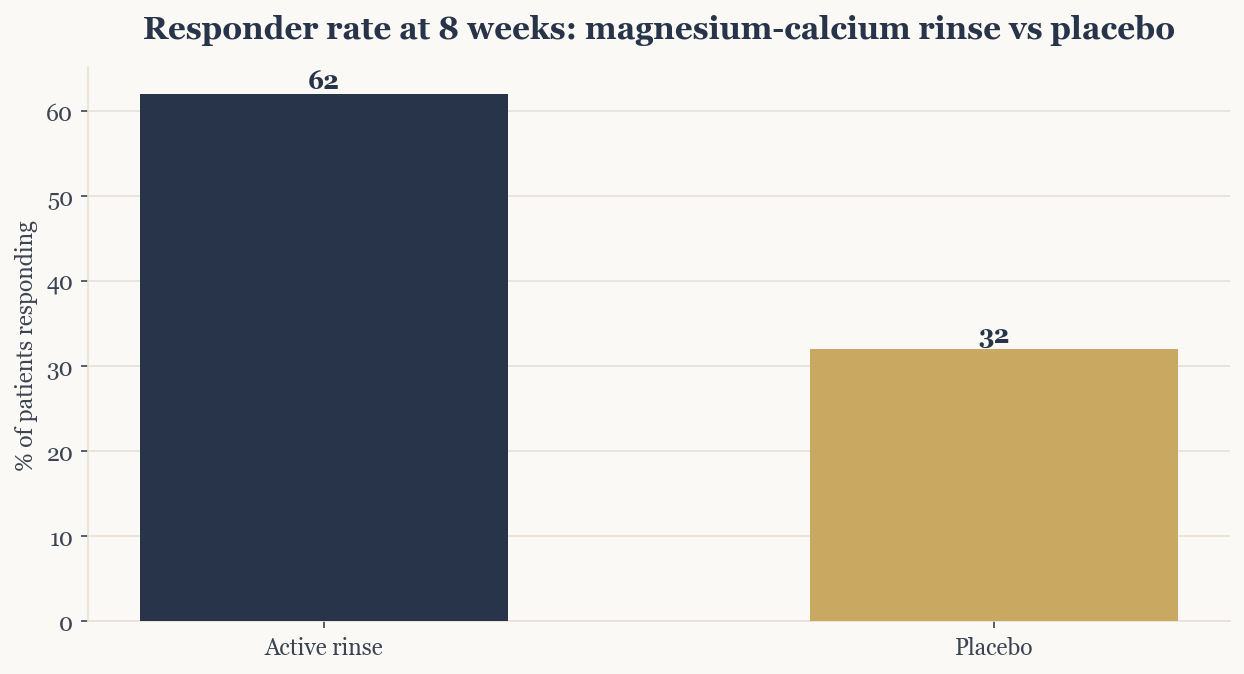
| Magnesium-calcium oral rinse | In a single, non-replicated randomized trial with retrospective trial registration: 62% responders (≥30% reduction in pain intensity, 0–10 scale) vs 32% with placebo over 8 weeks; mild, comparable side effects (PMID 42472793) | Patients seeking a topical option without systemic drug effects; evidence is preliminary and short-term |
| Systemic capsaicin | Pain improvement in a small pilot study (Petruzzi et al., J Oral Pathol Med 2004) | Selected patients under supervision, given limited trial size |
| Antidepressants / anticonvulsants (systemic) | Longstanding clinical use for neuropathic-type pain; not directly compared against the rinse above | Patients with more severe or refractory symptoms, or coexisting mood symptoms |
| Addressing contributing factors (deficiencies, candidiasis, dry mouth, ill-fitting appliances) | Standard first step in any workup | All patients, before or alongside pain-directed therapy |
The magnesium-calcium rinse trial is the newest data point here: an 8-week randomized, double-blind, placebo-controlled trial of 116 patients found a significantly greater drop in pain scores and improved oral health-related quality of life with the active rinse, with a similar side-effect profile to placebo. This trial’s registration was retrospective — meaning outcome measures were not pre-specified before the study began, which raises the possibility of outcome-switching bias — and it has not yet been independently replicated. It also was not compared head-to-head against clonazepam, capsaicin, or systemic medications, and the trial didn’t follow patients beyond 8 weeks — so how durable the benefit is, and how it stacks up against established options, isn’t yet known (PMID 42472793).
The chart below summarizes the responder rates from this single trial; it should be read alongside the retrospective-registration and non-replication caveats above.
For patients age 65 and older, treatment planning may also need to account for broader health factors. A cross-sectional, case-control study of 104 patients found older adults with BMS had markedly higher rates of polypharmacy (76.9% vs 30.8% in matched controls), along with more cognitive impairment, depressive symptoms, and lower quality of life — suggesting BMS in this age group often occurs alongside other vulnerabilities that are worth screening for. The small sample size and cross-sectional design mean the study can’t say whether BMS causes or results from this pattern (PMID 41885048).
When to see a specialist
Consider an orofacial pain evaluation if burning mouth symptoms have lasted more than a few weeks after your dentist and physician have ruled out an obvious cause, if the burning is affecting sleep, eating, or quality of life, or if standard remedies (denture adjustment, treating dry mouth, correcting a deficiency) haven’t helped. An orofacial pain specialist can apply structured diagnostic criteria, evaluate for overlapping conditions like oral dysesthesia, and coordinate a treatment plan tailored to your specific presentation.
For referring providers
BMS remains a diagnosis of exclusion; recommended workup includes CBC, iron/ferritin, B12/folate, fasting glucose, and evaluation for oral candidiasis or contact allergens before attributing symptoms to primary BMS. Newer optimized diagnostic criteria (94.1% sensitivity, 79.6% specificity, AUC 0.874), derived from a validating sample of 34 confirmed BMS cases, may improve consistency over legacy criteria sets but carry a low positive predictive value (7.4%) in that sample and in unselected populations more broadly, so confirmation via clinical assessment remains necessary; the small validation sample also limits generalizability (PMID 42244168). In patients presenting with both xerostomia and burning/dysesthesia, note that symptom severity correlates more with pain intensity and psychological distress than with objective salivary flow — this is based on a retrospective study, which precludes inference of causality, and sialogogue-focused treatment alone may be insufficient in this subgroup (PMID 41689369). In patients ≥65, consider screening for polypharmacy, cognitive change, and mood/social support given the association with frailty markers observed in this population, drawn from a small (n=104) cross-sectional case-control study (PMID 41885048). Topical magnesium-calcium rinse is an emerging option with placebo-controlled evidence at 8 weeks from a single trial with retrospective registration and no independent replication; it has no long-term or comparative-efficacy data against topical clonazepam, capsaicin, or systemic neuromodulating agents (PMID 42472793).
References
- PMID 42472793 — Efficacy of magnesium-calcium ionic oral rinse for primary burning mouth syndrome: a randomized, double-blind, placebo-controlled trial. BMC Oral Health, 2026.
- PMID 41689369 — Xerostomia in Patients With and Without Concomitant Oral Burning Pain And/Or Dysesthesia. Journal of Oral Rehabilitation, 2026.
- PMID 41705713 — Bridging Metabolomics and Nociception: The Arachidonic Acid-NMDA Receptor Axis in Burning Mouth Syndrome. Journal of Oral Rehabilitation, 2026.
- PMID 42244168 — Optimized and validated clinical diagnostic criteria for burning mouth syndrome. Cephalalgia, 2026.
- PMID 41508839 — Dysregulated proprioception in trigeminal pain: A novel perspective on oral dysesthesia. Cranio, 2026.
- PMID 41885048 — Uncovering Frailty in Burning Mouth Syndrome: Insights From a SUNFRAIL+ Based Multidimensional Assessment. Journal of Oral Rehabilitation, 2026.
