If you’ve been told you have obstructive sleep apnea and a CPAP mask isn’t for you, you may have heard about oral appliances that hold the lower jaw forward during sleep. A new study asks a practical question: can doctors predict, before you ever wear the device, how well it will work for you?
Key Points
- A 2025 multicenter study (n=77) tested whether a sleep endoscopy exam combined with an adjustable jaw-positioning tool could predict how patients respond to mandibular advancement device (MAD) therapy (PMID 42549506).
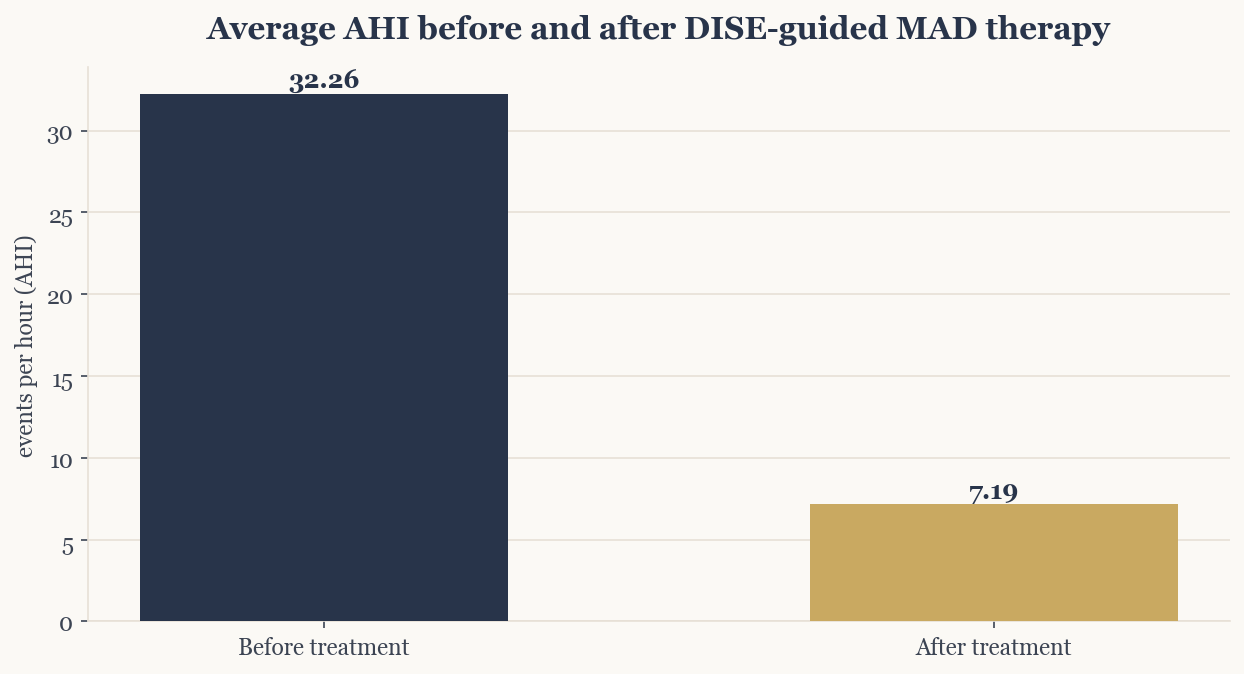
- In the 66 of 77 participants who completed follow-up, average AHI — a measure combining apneas (breathing pauses) and hypopneas (partial reductions in airflow) per hour of sleep — fell from 32.26 to 7.19 following DISE-SAM-guided MAD therapy. This is the overall treatment-outcome finding for the cohort, not a comparison between predicted responders and non-responders.
- Oxygen measures also changed in this completed-follow-up group: the lowest overnight oxygen reading rose from an average of 80.83% to 85.87%, and time spent below 90% oxygen dropped from 11.33% to 3.99% of the night.
- Separately, the study reported that the DISE-SAM protocol had positive predictive value for identifying likely treatment responders across mild, moderate, and severe OSA — meaning it was informative in classifying patients — but the source summary reviewed did not include the actual PPV, sensitivity, specificity, or NPV figures, so this predictive-accuracy claim is described qualitatively here.
- The baseline average AHI of 32.26 falls within the severe OSA range by standard classification; the full severity distribution of the n=77 cohort was not specified in the summary reviewed.
- The study had no control group and 11 of 77 patients were lost to follow-up, so the findings describe a promising screening approach, not a guarantee of individual results.
What is a mandibular advancement device, and why does prediction matter?
A mandibular advancement device (MAD) is a custom oral appliance, similar to a retainer, worn during sleep. It is understood to hold the lower jaw slightly forward, opening space in the airway, which is believed to reduce the airway collapse and vibration associated with snoring and apnea events in many patients.
MADs work well for many people, but not everyone. The airway can narrow at different levels — behind the tongue, the soft palate, or elsewhere — and jaw advancement doesn’t address every pattern of collapse equally well. Historically, confirming whether a MAD would help required fabricating the appliance, having the patient wear it for a trial period, and then repeating a sleep study to check the result.
How is treatment response predicted before the device is built?
The study evaluated a two-part protocol:
- Drug-induced sleep endoscopy (DISE): a brief procedure, performed under sedation to simulate natural sleep, in which a clinician looks directly at the airway with a small scope to see where and how it collapses. Because it requires sedation, DISE involves the procedural considerations and monitoring associated with any sedated endoscopic exam.
- A titratable mandibular positioner (referred to in the study as SAM): an adjustable device used during the same procedure to simulate different degrees of jaw advancement, so the clinician can observe, in real time, whether moving the jaw forward opens the airway — and by how much.
Because the jaw position is tested live under direct visualization, this approach aims to answer “will advancement help this specific airway?” before a custom appliance is fabricated.
What did the study find?
In the 66 of 77 participants who completed follow-up, sleep study measures improved substantially following DISE-SAM-guided MAD therapy:
This chart reflects the overall change in AHI for the treated cohort; it does not by itself indicate how many individual patients met a specific responder threshold, and 11 of the original 77 participants were lost to follow-up and are not represented in the post-treatment figures. Individual results vary.
Separately, the study assessed how well the DISE-SAM protocol predicted, in advance, which patients would respond to therapy. This predictive accuracy held up whether researchers used standard success criteria or criteria tailored to each patient’s disease severity — a distinction that matters because a fixed AHI cutoff doesn’t necessarily reflect meaningful improvement for every patient (PMID 42549506). The summary reviewed did not report the underlying PPV, sensitivity, specificity, or NPV values, so this finding should be treated as qualitative.
Which treatment is right for me?
Oral appliance therapy is one of several evidence-based options for OSA. The right choice depends on apnea severity, airway anatomy, and personal factors like CPAP tolerance.
| Approach | What the evidence shows | Best suited to |
|---|---|---|
| CPAP | Long-established first-line therapy; effective when used consistently, though real-world nightly adherence is a well-documented limiting factor for many patients | Moderate-to-severe OSA; patients who tolerate the mask nightly |
| Standard MAD (no pre-screening) | Effective for many patients, but response varies by airway anatomy | Mild-to-moderate OSA, CPAP-intolerant patients |
| DISE-SAM guided MAD | In this study’s completed-follow-up cohort (n=66 of 77 enrolled; baseline mean AHI in the severe range), AHI fell from 32.26 to 7.19; the protocol also showed predictive value for identifying likely responders across severity levels, though exact predictive statistics were not reported in the summary reviewed (PMID 42549506) | Patients considering a MAD who want airway-collapse pattern confirmed first; candidacy should be assessed individually rather than restricted by severity |
Figures for DISE-SAM MAD come from a single study without a control group; individual results vary, and this is not a guarantee of outcome. No single option is universally “best” — treatment is a decision made jointly between patient and clinician based on the diagnostic picture.
How is OSA diagnosed?
Diagnosis starts with a sleep study, either in a lab or at home, which measures the AHI along with oxygen saturation. Values are used to classify severity (mild, moderate, severe) and guide treatment discussion. For patients considering a MAD, an airway exam — and in select cases, DISE — helps determine whether jaw advancement is likely to address the specific pattern of airway collapse seen on that patient’s scope exam.
When should I see a specialist?
Consider a referral or evaluation if you snore loudly, wake up gasping, feel excessively tired despite adequate sleep time, or have been diagnosed with OSA but haven’t tolerated CPAP. A dentist practicing dental sleep medicine can assess airway anatomy, coordinate with your sleep physician, and determine whether appliance therapy — with or without DISE guidance — fits your case.
For referring providers
The DISE-SAM protocol described in this study offers a pre-treatment screening step for MAD candidacy: real-time visualization of airway collapse under simulated jaw advancement, using a titratable positioner during drug-induced sleep endoscopy. DISE itself requires sedation and the associated procedural monitoring, which is a scheduling and patient-selection consideration distinct from the appliance fitting itself.
In this cohort (n=77; 66 completing follow-up), the treated group’s average AHI fell from 32.26 to 7.19, with corresponding improvements in oxygen measures. Baseline mean AHI falls in the severe range by standard classification; the full severity distribution of the cohort was not specified in the summary reviewed, so DISE-SAM candidacy should not be assumed to generalize across all severities without individualized assessment.
Separately, the protocol demonstrated positive predictive value for treatment response across OSA severity strata, under both conventional and severity-tailored response criteria (PMID 42549506); the summary reviewed did not report the underlying PPV, sensitivity, specificity, or NPV, and these should be confirmed from the full published study before this predictive claim informs clinical decision-making. Additional limitations include the absence of a control arm, moderate sample size, 11 patients lost to follow-up, and no reported long-term outcome data; the DISE-SAM equipment and expertise required may also limit availability outside specialized centers.
For patients who have failed or declined CPAP and are being considered for oral appliance therapy, DISE-guided titration may help refine candidate selection before appliance fabrication — a determination best made in consultation with a dentist practicing dental sleep medicine.
References
- Tailored Mandibular Advancement Therapy Guided Through a Mandibular Positioner: Predictive Value in Obstructive Sleep Apnea. PMID 42549506
This article is educational and does not replace an individualized sleep and airway evaluation. If you’d like to discuss whether DISE-guided oral appliance therapy may be appropriate for you, an evaluation is available at our clinic.
