
If your jaw joint aches, clicks, or feels stiff from arthritis, you may have heard about ozone injections as a treatment option. Here’s what a recent study found — including a discomfort trade-off worth knowing before you consider it.
Key Points
- Intra-articular ozone-oxygen gas injected into the TMJ (temporomandibular joint, the jaw joint in front of the ear) significantly reduced joint tenderness, joint sounds, and chewing difficulty in a small open-label study (PMID 42230177).
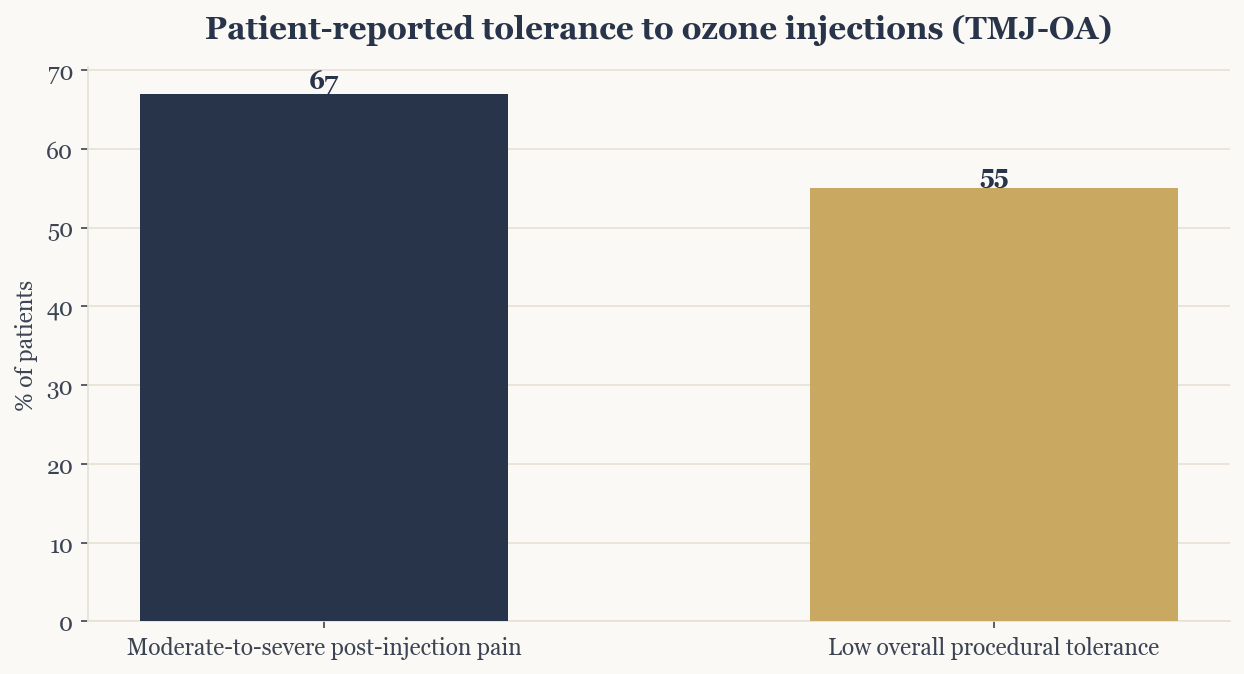
- Most patients — 67% — experienced moderate-to-severe pain right after the injection, and just over half rated the procedure itself as poorly tolerated.
- Patients with more painful jaw opening or more advanced bone erosion on imaging before treatment were more likely to tolerate the injections poorly.
- The study had no comparison group and did not follow patients long-term, so how ozone stacks up against other TMJ-OA treatments — or whether benefits last — remains unclear.
- Other injectable and procedural options for TMJ osteoarthritis (arthrocentesis, PRP, hyaluronic acid) have more established evidence bases.
What is TMJ osteoarthritis?
Temporomandibular joint osteoarthritis (TMJ-OA) is a “wear and tear” condition of the jaw joint. The cartilage cushioning the joint breaks down over time, the underlying bone can erode, and the joint becomes inflamed. This typically shows up as pain when chewing or pressing on the joint, clicking or grinding sounds, and a jaw that feels stiff or doesn’t open as far as it used to.
What is intra-articular ozone therapy?
Intra-articular ozone therapy means injecting a mix of ozone and oxygen gas directly into the joint space. Proponents suggest it may calm inflammation and ease pain, similar in concept to other injectable joint treatments like corticosteroids or hyaluronic acid (a naturally occurring joint lubricant with proposed anti-inflammatory and protective properties [Comparison Between Two Viscosupplementation Protocols]).
A 2026 open-label study tested this in 49 patients with TMJ-OA, giving four weekly injections of ozone-oxygen gas (PMID 42230177). The results on paper looked encouraging: statistically significant drops in joint tenderness when pressed (palpation pain), joint sounds, and chewing difficulty, all with strong statistical confidence (p=0.001).
The trade-off: what patients actually experienced
Here’s the part that matters most for deciding whether this is right for you. The same study measured how patients tolerated the injections themselves — not just whether their symptoms improved afterward.
67% of patients reported moderate-to-severe pain immediately following injection, and 55% rated their overall tolerance of the procedure as low. In other words, roughly two out of three patients found the injection itself notably uncomfortable, and just over half found the experience difficult to get through.
The study also identified who was most likely to struggle: patients whose jaw already hurt when opening wide, and patients with more severe bone erosion visible on imaging, were more likely to report poor tolerance. This suggests the injections may be harder to tolerate precisely in the patients whose joints are already more damaged or symptomatic — an important consideration for shared decision-making.
Because this was an open-label study with no comparison group (no placebo or alternative treatment arm) and no long-term follow-up, it’s not possible to say how much of the symptom improvement would have happened anyway, or whether the benefit outweighs the discomfort over time.
How does ozone compare to other TMJ-OA treatments?
Several other injectable and procedural approaches for TMJ-OA and related joint disorders have been studied more extensively:
| Treatment | What the evidence shows | Notable limitation |
|---|---|---|
| Ultrasound-guided arthrocentesis (joint flushing) | Improved maximal mouth opening by 2.30 mm; outperformed splint therapy for both function and pain (PMID 42302358) | Modest magnitude of functional gain |
| Platelet-rich plasma (PRP) injection | Greater pain reduction than other approaches at 6-month follow-up (PMID 42302358) | Study heterogeneity limits direct comparison |
| Arthrocentesis + iPRF or PRP-hyaluronic acid vs. saline | No significant difference in pain reduction between groups at 12 months; PRP-HA showed lower joint noise and more consistent opening as secondary findings (PMID 42247967) | Small, unequal groups; secondary findings not confirmed prospectively |
| Intra-articular ozone-oxygen | Significant improvement in joint tenderness, sounds, and chewing efficiency | High rate of injection pain (67%) and low procedural tolerance (55%); no control group (PMID 42230177) |
How is TMJ osteoarthritis diagnosed?
Diagnosis typically combines a clinical exam — checking for joint tenderness, restricted or asymmetric opening, and joint sounds — with imaging (often CT or MRI) to assess bone erosion and cartilage condition. The degree of erosion seen on imaging matters not just for staging the disease, but, per this new evidence, potentially for predicting how a patient will tolerate certain injectable treatments.
Which treatment is right for me?
There is no single “best” injectable therapy for TMJ-OA established by current evidence. The right choice depends on symptom severity, imaging findings, prior treatment response, and — as this study highlights — a patient’s expected tolerance for a moderately painful procedure. Conservative measures (splint therapy, physical therapy, behavioral strategies) are generally tried first. Arthrocentesis and biologic injections (PRP, PRP-HA) have larger and more comparative evidence bases than ozone at this time. Ozone therapy may be discussed as an option in select cases, but patients should have a clear, honest conversation about the discomfort reported in this study before proceeding.
When should I see a specialist?
If jaw pain, clicking, or limited opening is persistent, worsening, or interfering with eating or daily function, evaluation by a clinician experienced in TMJ disorders is appropriate — especially before considering an injectable procedure, so that imaging and joint status can guide which option, if any, fits your situation.
For referring providers
The available data on intra-articular ozone for TMJ-OA (PMID 42230177) come from a single open-label cohort (n=49) without a control arm or long-term follow-up. While palpation pain, joint sounds, and masticatory efficiency improved significantly (p=0.001), the high rate of post-injection pain (67% moderate-to-severe) and low procedural tolerance (55%) — associated with pre-treatment pain on maximal opening and greater condylar erosion — merit discussion with patients before referral for this modality. Comparatively, arthrocentesis and PRP-based protocols have larger, though still heterogeneous, evidence bases (PMID 42302358, PMID 42247967). Patients being considered for total joint replacement should be counseled based on prosthesis type; stock and customized designs show favorable long-term complication profiles, while extended prostheses carry substantially higher risk, likely reflecting more complex case selection (PMID 42258893).
References
- PMID 42230177 — Pain perception and patient tolerance to intra-articular ozone-oxygen injections in the treatment of temporomandibular joint osteoarthritis.
- PMID 42302358 — Comparative efficacy of arthrocentesis, platelet-rich plasma (PRP), and conservative therapies for TMJ disorders: A systematic review and meta-analysis.
- PMID 42247967 — Arthrocentesis with iPRF, PRP + hyaluronic acid, or saline in arthrogenic TMD: 12-month outcomes from a retrospective cohort study.
- PMID 42258893 — Complications following stock, customized, and extended total alloplastic temporomandibular joint replacement: a 10-year retrospective cohort study.
